Landmark National Action Plan Opens a New Window for the Lighting Industry's Digital and Intelligent Transformation
- Share
- From
- www.lightingchina.com.cn
- Issue Time
- Jul 9,2026
Summary
As a leading industry media platform, China Lighting Network (Alighting.cn) will continue to monitor the implementation of these national policies and the industry's practical progress.

The release of the Action Plan for Innovation in Typical Application Scenarios of "Artificial Intelligence + Transportation" marks the beginning of a new phase in the digital and intelligent transformation of the lighting industry. At the national strategic level, the plan recognizes smart light poles as a critical component of next-generation transportation infrastructure and outlines a clear pathway for lighting companies to evolve from traditional lighting manufacturers into providers of smart transportation infrastructure solutions.
As the first batch of implementation guidelines for typical application scenarios under China's 15th Five-Year Plan is gradually introduced, demonstration projects are expected to accelerate across the country. This policy-driven momentum will reshape the competitive landscape of the lighting industry, creating a new wave of market differentiation. Companies that seize this policy opportunity, embrace technological innovation, and successfully transform their business models will gain a significant competitive advantage. Those that continue to rely on traditional manufacturing approaches risk being left behind as the industry undergoes rapid upgrading.
As a leading industry media platform, China Lighting Network (Alighting.cn) will continue to monitor the implementation of these national policies and the industry's practical progress. By promoting industry collaboration and facilitating resource integration, the platform aims to support the lighting sector's participation in China's next-generation transportation infrastructure and witness this important stage in the industry's evolution.
On June 25, 2026, China's Ministry of Transport, together with several other central government departments, officially released the Action Plan for Innovation in Typical Application Scenarios of "Artificial Intelligence + Transportation" (Jiao Ke Ji Fa [2026] No. 60). The document presents an ambitious roadmap for integrating artificial intelligence with the transportation sector throughout the 15th Five-Year Plan period and beyond.
A closer examination of the Action Plan reveals that it is far more than a standalone transportation policy. It represents a national-level strategic initiative that provides top-level planning for the lighting industry—particularly the road lighting and smart light pole sectors. The plan formally incorporates roadside sensing infrastructure based on smart light poles into the core framework of China's integrated intelligent transportation network.
Against this backdrop, the Action Plan establishes a clear policy direction for the digital and intelligent transformation of the lighting industry while opening up significant new opportunities for industrial development. It signals the transition of lighting infrastructure from a traditional illumination function to an essential component of intelligent transportation systems, creating a broad new market for companies capable of delivering integrated smart infrastructure solutions.
Ⅰ. A Shift in Policy Direction: From Municipal Infrastructure to the Foundation of Intelligent Transportation Sensing
Looking back at the industry's evolution, smart light poles originated as an extension of intelligent municipal lighting systems. For many years, they were regarded primarily as supporting infrastructure for urban public services, with applications largely limited to city roads. Their value proposition focused mainly on "multiple functions integrated into a single pole," emphasizing hardware integration and equipment consolidation.
The release of the Action Plan marks a fundamental shift in this positioning. Smart light poles are no longer viewed merely as lighting products or municipal facilities. Instead, they have been elevated to become the core physical platform supporting China's national "Artificial Intelligence + Transportation" strategy and a key component of the country's next-generation transportation infrastructure.
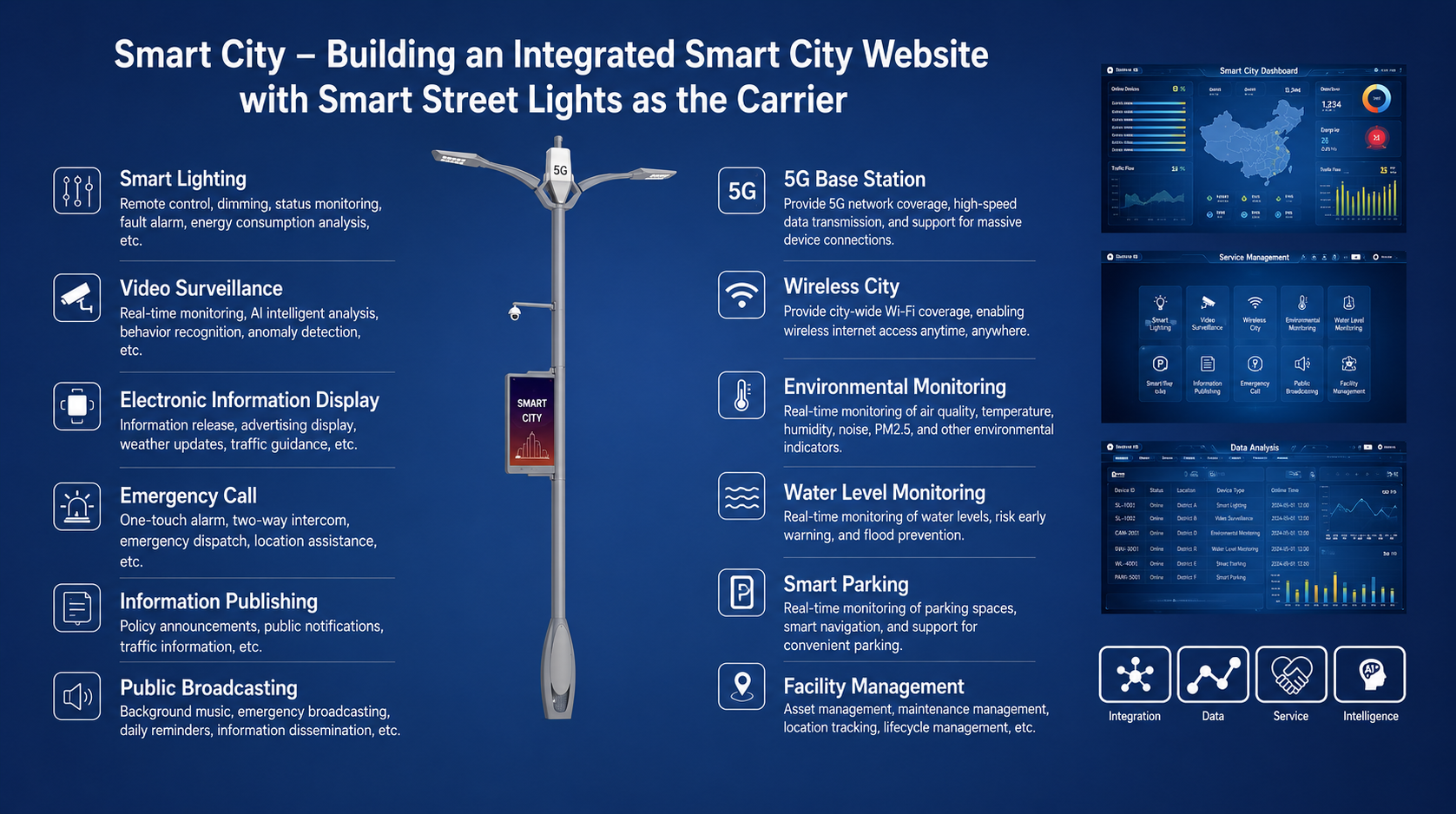
The Action Plan clearly states that by 2030, four major outcomes are to be achieved: new infrastructure, new technologies and equipment, new service models, and new industrial ecosystems. Significantly, new infrastructure is listed as the top priority. This clearly establishes intelligent roadside poles as part of the nation's critical infrastructure. In other words, smart light poles are now recognized alongside smart highways, intelligent railways, and smart ports as key components of China's next-generation transportation infrastructure.
This strategic repositioning also transforms the development model for smart light poles. What was once primarily procured through municipal engineering projects is now incorporated into the country's broader transportation infrastructure strategy. Responsibility for deployment is expanding beyond traditional municipal and housing authorities to include transportation departments, resulting in significantly larger investment, wider geographic coverage, and a much higher level of strategic importance.
For the lighting industry, this represents a fundamental policy breakthrough. In the past, discussions around smart light poles were often constrained by fragmented market demand, inconsistent technical standards, and limited profit margins. The new Action Plan fundamentally changes this landscape by identifying "multi-pole integration" and "multi-sensor integration" as one of the core approaches to developing intelligent highways.
Ⅱ. Unlocking Opportunities Across Ten Key Application Scenarios: Integrating Lighting into the Entire AI-Powered Transportation Ecosystem
The Action Plan identifies ten major development areas and introduces dozens of representative application scenarios. Many of these are closely connected to the lighting industry, creating multiple entry points for companies seeking to participate in the next generation of intelligent transportation infrastructure.
(1) Smart Highways: The Primary Growth Engine, with Smart Light Poles as the Optimal Platform for Comprehensive Sensing
Among all the application scenarios outlined in the Action Plan, smart highways have the strongest connection to the lighting industry and represent the most immediate opportunity for market growth.
The Action Plan explicitly proposes leveraging existing roadside sensing infrastructure by adopting integrated approaches such as "multi-pole integration" and "multi-sensor integration." Combined with advanced technologies including multimodal large AI models, these intelligent roadside systems will significantly enhance the comprehensive perception capabilities of highway infrastructure, traffic operations, and the surrounding road network environment.

For the lighting industry, this statement conveys three key strategic signals that will shape the sector's future development.
First, light poles become the core infrastructure platform. Along highways, lighting poles are the most widely distributed, evenly spaced, and reliably powered infrastructure assets. The concept of "multi-pole integration" is essentially based on using street lighting poles as the primary platform to consolidate surveillance poles, traffic sign poles, communication poles, and signal poles into a unified infrastructure system, enabling centralized and integrated deployment of multiple roadside facilities. Thanks to their extensive expertise in pole design, power supply systems, and installation planning, lighting companies are naturally well positioned to become the primary developers of this "one pole, multiple functions" model.
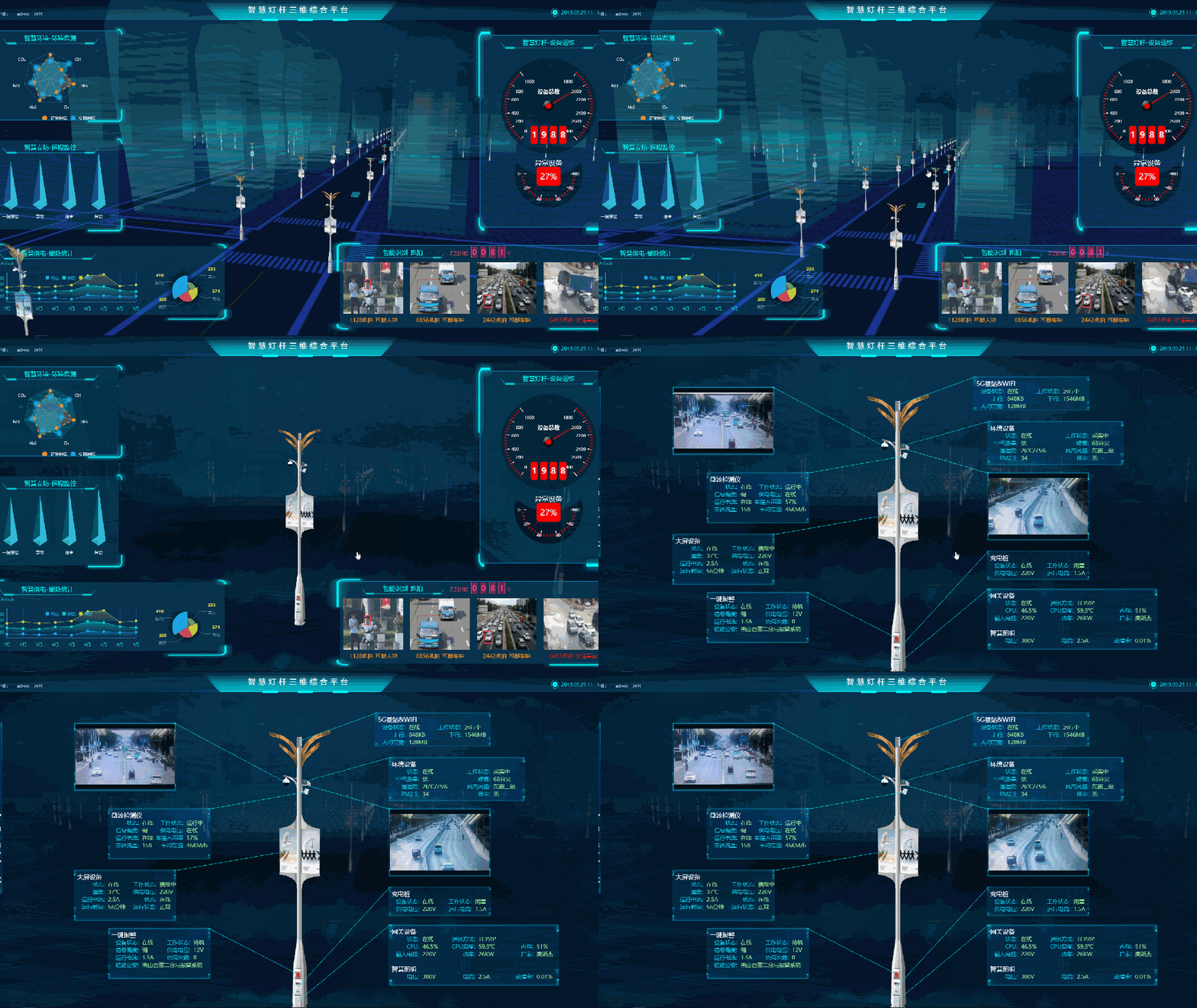
Second, "multi-sensor integration" drives product upgrading. The Action Plan calls for far more than simply installing additional sensors. It requires comprehensive, all-element perception of transportation infrastructure, traffic operations, and the road network environment under a wide range of complex conditions, including nighttime, rain, snow, and construction zones. As a result, smart light poles must evolve from serving merely as platforms for mounting integrated equipment to becoming intelligent hubs that fuse multiple sensing technologies. They will need to incorporate capabilities such as AI-powered video analytics, millimeter-wave radar, environmental monitoring, and road condition detection. This significantly raises the requirements for system integration while also increasing the technological sophistication and added value of lighting products.
Third, multimodal foundation models redefine the value of smart light poles. Once roadside sensing data is integrated into multimodal AI foundation models, smart light poles evolve from simple data collection terminals into edge intelligence nodes capable of supporting critical transportation applications such as traffic flow prediction, congestion management, free-flow tolling, and accident early warning. Consequently, the value of lighting products extends far beyond illumination. They become deeply integrated into transportation safety, operational efficiency, and intelligent traffic management. Revenue models will likewise evolve beyond hardware sales to include long-term service offerings such as data analytics, system operation, maintenance, and other value-added digital services.
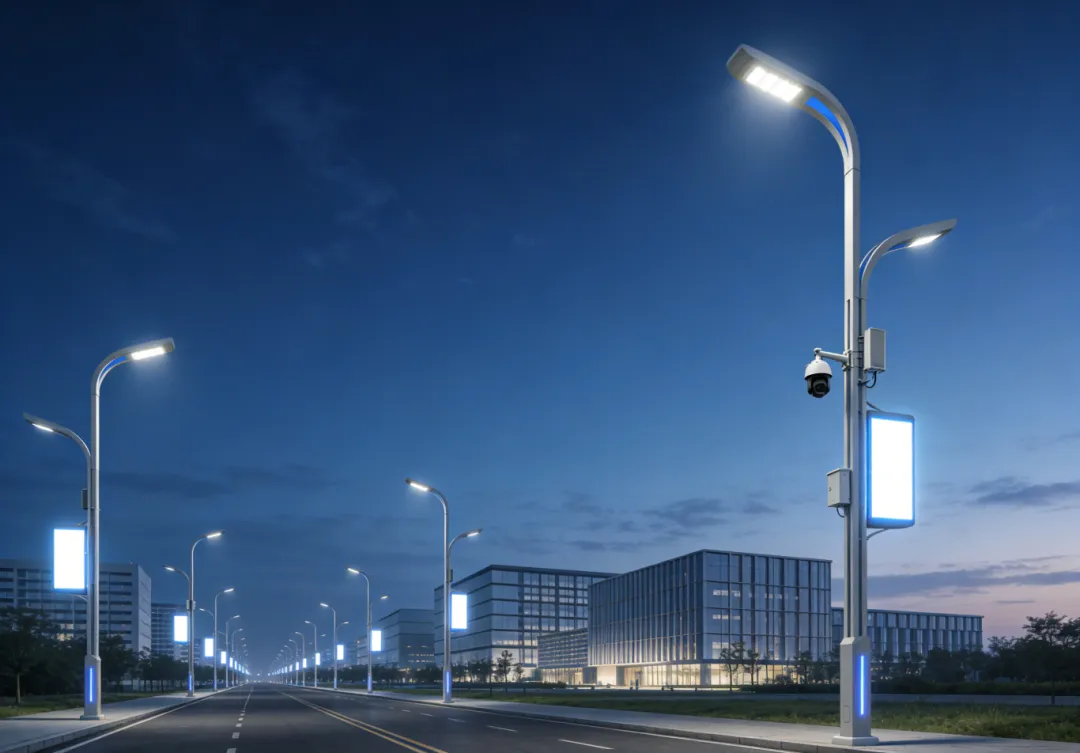
(2) Multi-Scenario Integration: Expanding the Boundaries of the Lighting Industry
Beyond intelligent highways—the industry's primary growth area—the Action Plan also creates a wide range of differentiated opportunities for lighting companies across multiple application scenarios.
Intelligent Construction and Infrastructure Maintenance: The Action Plan calls for AI-powered defect detection, intelligent inspection, and full life-cycle management of bridges, tunnels, and road pavements. Lighting companies can leverage their existing expertise in tunnel and bridge lighting by integrating structural monitoring sensors, defect detection technologies, and other intelligent sensing devices into lighting infrastructure. This enables the development of integrated "lighting + infrastructure monitoring" solutions, allowing lighting systems to become an essential part of transportation infrastructure operation and maintenance services.
Intelligent Safety Supervision: The Action Plan emphasizes strengthening traffic safety monitoring, rapid incident detection, and digital, AI-enabled law enforcement. Nighttime and adverse weather conditions remain the periods with the highest accident risk and are also the primary operating scenarios for roadway lighting systems. By combining intelligent lighting with AI-powered sensing technologies, lighting systems can improve road visibility under low-light conditions, enhance incident detection and early warning capabilities, and evolve from simply ensuring visibility to ensuring safe traffic operations.
Intelligent Transportation Services: The Action Plan also proposes establishing multimodal travel planning systems and promoting integrated mobility services. As distributed roadside service nodes, smart light poles can support a variety of public functions, including real-time travel information, transfer guidance, and emergency assistance. Their role can be further expanded to provide a broader range of public services, strengthening the value of lighting infrastructure as an integral component of smart city services rather than simply an illumination device.
In addition, specialized lighting systems used in intelligent railways, smart shipping, and smart civil aviation can also benefit from AI technologies. Intelligent control, adaptive lighting, energy-efficient operation, predictive maintenance, and enhanced safety support will create new opportunities for digital and intelligent transformation across multiple segments of the lighting industry.
III. Three Major Development Trends: Reshaping the Future Growth Logic of the Lighting Industry
From the perspective of the lighting industry as a whole, the policy incentives and strategic direction outlined in the Action Plan are expected to bring profound changes to the industry's development. Beyond creating new market opportunities, the plan will fundamentally reshape the industry's growth model, redefine its competitive landscape, and establish a new framework for long-term innovation and value creation.
Trend 1: Market Expansion — From "Urban Municipal" to "Full Road Network"
Smart street lamps previously served only urban built-up areas for municipal authorities. This solution extends coverage to trunk roads and expressways, expanding the market from cities to the entire national highway network. Clients now include transport ministries and highway operators, with demands shifting from scattered pilots to systematic construction. This lifts the industry's growth ceiling, making the transportation sector the next 100-billion-yuan core market for tech-capable lighting firms.
Trend 2: Value Shift — From "Hardware Manufacturing" to "Smart Services"
Long trapped in homogenization and price wars, the road lighting industry has long suffered low added value. The new "multi-in-one pole + AI perception" model redefines value around perception systems, algorithms, data services and operation management. Future competition will focus on multi-sensor fusion, edge computing, scenario-based algorithms and long-term services, pulling the industry out of price competition into a tech-driven value era.
Trend 3: Role Upgrade — From "Equipment Supplier" to "Infrastructure Service Provider"
Traditional lighting firms stayed at the low end of the value chain with weak influence. In the AI-transport integrated ecosystem, smart street lamps form the core of roadside perception networks. Lighting enterprises can now deeply engage in the full lifecycle of smart expressway design, construction and maintenance, becoming key partners in new transport infrastructure. This enables deep collaboration with AI firms, telecom operators and transport tech players, building a complete smart highway ecosystem and unlocking new business possibilities.
Ⅳ. Industry Reflection: Challenges Under Opportunities and Solutions

While seizing policy dividends, we must clearly recognize that many practical issues remain to be resolved from policy rollout to industrial implementation. Lighting practitioners should get fully prepared and proactively tackle these challenges.
The industry currently faces three core challenges:
Cross-domain capability barriers: Most lighting firms master lighting technologies and municipal scenarios, but lack in-depth knowledge of transportation business logic, multi-modal perception tech and vehicle-road coordination standards, failing to well meet the demands of the transportation sector. Cross-department collaboration difficulties: The "multi-pole integration" initiative involves multiple authorities including transport, municipal administration, public security, telecom and power. Mechanistic barriers still exist in defining pole ownership, data rights and operation & maintenance responsibilities, leading to extremely high coordination costs for implementation. Business model to be further validated: The construction of smart highways and smart street lamps features high upfront investment and slow returns. Relying solely on hardware sales cannot sustain long-term operation, while highly actionable service-oriented business models are still under exploration.

The industry currently faces three core challenges:
Cross-domain capability barriers: Most lighting firms master lighting technologies and municipal scenarios, but lack in-depth knowledge of transportation business logic, multi-modal perception tech and vehicle-road coordination standards, failing to well meet the demands of the transportation sector. Cross-department collaboration difficulties: The "multi-pole integration" initiative involves multiple authorities including transport, municipal administration, public security, telecom and power. Mechanistic barriers still exist in defining pole ownership, data rights and operation & maintenance responsibilities, leading to extremely high coordination costs for implementation. Business model to be further validated: The construction of smart highways and smart street lamps features high upfront investment and slow returns. Relying solely on hardware sales cannot sustain long-term operation, while highly actionable service-oriented business models are still under exploration.
Four targeted suggestions for the industry's development:
1. Speed up tech integration to develop scenario-adapted products. Enterprises shall accelerate the layout of integrated smart street lamp products featuring "lighting + perception + edge computing", adjust product structures to meet highway requirements for speed, all-weather performance and high reliability, and actively adapt to the access demands of multi-modal large models, so as to build a hardware base that enables full perception of all traffic elements.
2. Proactively engage in the track and deeply participate in pilot demonstration projects. The action plan defines three paths: application promotion, innovation demonstration and key breakthrough. Lighting enterprises shall actively connect with transport authorities and highway operators, cooperate with AI firms and research institutes to join the construction of innovation demonstration projects, continuously optimize products in real scenarios and accumulate practical experience to seize first-mover opportunities.
3. Participate in standard-setting to gain industry discourse power. The plan proposes to build a standard system for "AI + transportation". The lighting industry shall speak up and get involved proactively, integrating its technical experience and industrial demands into national and industrial standard formulation to safeguard its development rights in the new track.
4. Explore new models to form a sustainable business closed loop. Lighting enterprises shall gradually abandon the old mindset of "valuing construction over operation", explore an integrated business model covering "construction + operation & maintenance + data analysis services", and realize the transformation from one-off project revenue to continuous service revenue through value-added traffic big data services, energy-saving & eco-friendly operation management, and facility entrusted operation & maintenance.